



When AI-generated content was labeled as such in the UK, 27% of those reacting said they would block those accounts. But 42% didn't care. And this split decision is why you will see more AI – not less.
But social media requires real people. Once the humans leave? Social media looks a lot like your email spam folder.
On Facebook, you may have noticed an increase in the number of sponsored posts throughout your feed. Some are obvious ads but others are created to fly under the radar – unposed photos, unglamorous settings, casual commentary. At first glance it could be a friend... scroll back up. Who was that? Oh, no one.
One afternoon I counted 6 legitimate posts peppered amid 40 fake posts. Reducing everything (friends, groups, pages) had no effect on this. As a result, I spend very little time on Facebook.
Still, businesses plan to use AI to generate about half of their social media by 2026 while experts warn that when you add AI-generated art and disinformation, 90% of content will be AI-generated by 2026.
Why? Picture an absolute dog fight among influence marketers trying to maintain their tenuous positions in the food chain, amid abject desperation to generate revenue fueled by AI's capacity to crank soulless content 24:7. If 90% of Facebook is AI generated, however, where are the real people with their real money?
AI in social media has only one purpose: generate revenue from humans – faster and more effectively.
But when you suddenly realize that everything in your feed is fake? AI generated photos of places that do not – and cannot – exist on earth. Lively comments and conversations that are completely bot-driven. Videos that require too much detective work to figure out if they are real. Sophisticated disinformation. AI-fueled scams that become harder to detect.
AI in social media causes us to continually question everything. It erodes the public trust. It's exhausting and depressing.
Virtually every study agrees that AI has always had a trust problem. Public trust in AI companies dropped from 50% to 35% in five years (also Forbes) or Newsweek's "AI and the Collapse of Societal Trust ." Or this Gallup poll:
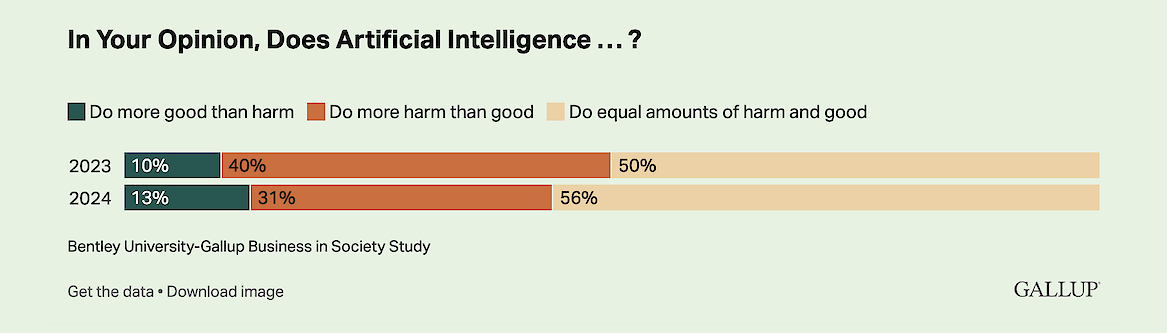
That trust problem is intrinsic to the core of AI. It's a child technology created without consent. More human than human.
In a recent Forbes article, 5 Tips for Creators Leveraging AI in Social Media Platforms, I found this cheerfully pro tip for using AI:
Foster Authenticity: Prioritize authenticity in your content creation efforts and leverage AI to amplify your unique voice and perspective, building trust and credibility with your audience.
Here's my pro tip: AI cannot amplify your unique voice. It cannot build trust. It has no capacity to offer perspective. And it may destroy your credibility. Social media, by definition, is the last place you should see AI.